
Blog Details
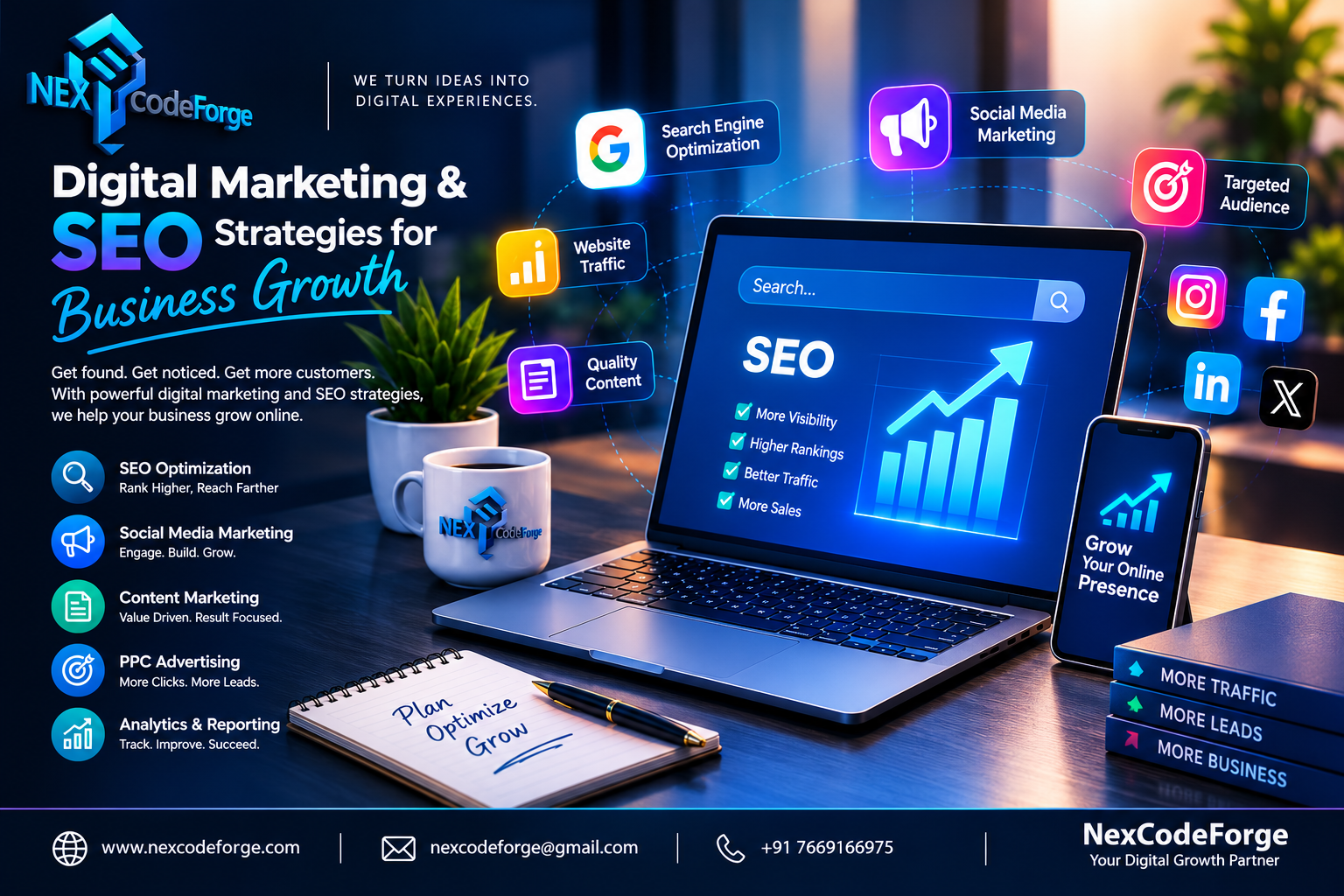
Digital Marketing and SEO: Proven Strategies to Grow Your Business Online
Introduction
In today's digital world, having a business is not enough. Your potential customers need to find you online, understand your services, and trust your brand before making a purchase. Whether you own a café, clothing store, clinic, gym, real estate agency, or any other business, establishing a strong online presence can help you reach more people.
Digital marketing and Search Engine Optimization (SEO) are two important strategies that help businesses connect with their target audiences, promote their services, and build brand awareness.
At NexCodeForge, we understand the importance of a strong digital presence. Through website development and digital solutions, we help businesses establish a professional online identity and build a foundation for long-term growth.
Let's explore digital marketing and SEO, their benefits, and how your business can use them effectively.
1. What Is Digital Marketing?
Digital marketing is the process of promoting products, services, and brands through online channels. It allows businesses to connect with potential customers where they spend much of their time: on search engines, websites, social media platforms, and other digital channels.
Unlike traditional marketing methods, digital marketing offers opportunities to reach specific audiences and measure campaign performance.
Common Types of Digital Marketing
Search Engine Optimization (SEO): Improving website content and structure to help search engines understand your pages and help potential customers discover your business.
Social Media Marketing: Promoting your business through platforms such as Instagram, Facebook, LinkedIn, and other relevant social networks.
Content Marketing: Publishing useful blog articles, guides, images, and videos to educate your audience and establish credibility.
Pay-Per-Click Advertising (PPC): Running paid advertisements on platforms such as Google Ads to reach audiences who may be interested in your products or services.
Email Marketing: Sharing relevant updates, offers, and information with subscribers who have chosen to hear from your business.
Website Marketing: Using a professional website to showcase your services, answer customer questions, build trust, and generate enquiries.
An effective digital marketing strategy combines suitable channels according to your business goals, audience, and budget.
2. What Is Search Engine Optimization (SEO)?
Search Engine Optimization, commonly known as SEO, involves improving your website so search engines can better understand its content and users can discover relevant pages through organic search results.
For example, imagine someone searches Google for "best website development company" or "professional website design services." A well-optimized website may have a better opportunity to appear for relevant searches, depending on competition, content quality, and other ranking factors.
SEO is not a shortcut to instant rankings. It requires consistent effort, useful content, technical improvements, and attention to the needs of your audience.
Important Types of SEO
On-Page SEO
On-page SEO focuses on optimizing the content and elements of individual web pages.
It includes:
- Using relevant keywords naturally.
- Writing descriptive page titles and meta descriptions.
- Organizing content with clear headings.
- Creating useful, original content.
- Optimizing images and their alternative text.
- Adding relevant internal links.
Technical SEO
Technical SEO helps search engines discover, crawl, and understand your website.
Important areas include:
- Mobile-friendly website design.
- Fast and reliable page performance.
- Logical website structure.
- Secure HTTPS connections.
- Search engine indexing and crawlability.
- Fixing broken links and technical errors.
Off-Page SEO
Off-page SEO focuses on activities outside your website that can support your online reputation and visibility.
Examples include:
- Earning relevant backlinks from trustworthy websites.
- Building brand awareness.
- Publishing useful content that others may reference.
- Developing relationships within your industry.
- Maintaining consistent and credible business information.
Local SEO
Local SEO helps businesses improve their visibility in location-based searches.
For example, a café in Delhi may want to reach people searching for cafés nearby. A local SEO strategy can include optimizing a Google Business Profile, maintaining accurate business details, collecting genuine customer reviews, and creating relevant location-specific website content.
Local SEO is particularly valuable for restaurants, clinics, salons, gyms, retail stores, and other businesses serving a specific area.
3. Why Is Digital Marketing Important for Your Business?
Customers increasingly use the internet to research products, compare services, and evaluate businesses before contacting them.
Digital marketing can help your business reach these potential customers.
Increase Brand Awareness
Regularly publishing useful content and maintaining an active online presence helps more people become familiar with your brand.
Reach Your Target Audience
Digital channels allow you to tailor content and campaigns to particular audiences based on factors such as interests, location, and search intent.
Generate Quality Leads
A well-designed website, relevant content, and clear calls to action can encourage interested visitors to contact your business, request a quotation, or book a service.
Build Customer Trust
Professional website design, accurate business information, helpful content, and authentic customer reviews can help establish credibility.
Measure Marketing Performance
Analytics tools can help you understand website traffic, visitor behavior, enquiries, and campaign performance. This information supports more informed marketing decisions.
Support Long-Term Business Growth
Consistent marketing efforts can help businesses develop a recognizable brand, strengthen customer relationships, and create opportunities for future growth.
However, results depend on your industry, competition, budget, strategy, and execution. Digital marketing does not guarantee a particular number of leads or sales.
4. How SEO and Digital Marketing Work Together
SEO and digital marketing serve different purposes, but they become more effective when planned together.
SEO helps people discover relevant pages through organic search. Social media marketing helps distribute content and build audience engagement. Content marketing answers customer questions, while a professional website gives visitors a place to learn about your business and take the next step.
Consider a clothing store that wants to increase its online reach.
- The business launches a professional website featuring its collections.
- SEO helps organize product pages and optimize relevant search terms.
- Blog articles provide styling tips and useful fashion information.
- Instagram and Facebook content introduces products to potential customers.
- Clear enquiry or shopping options help interested visitors take action.
- Analytics help the business evaluate performance and identify opportunities for improvement.
By combining these activities, the business can build a more consistent digital presence instead of relying on a single marketing channel.
5. The Importance of a Professional Website in Digital Marketing
Your website is often one of the first places potential customers visit when researching your business.
Even an effective social media campaign may lose opportunities if interested visitors cannot find clear information about your services, pricing, location, or contact details.
A professional website can serve as your business's central online destination.
Essential Features of a Business Website
Responsive Design: Your website should work smoothly on smartphones, tablets, and desktop computers.
Clear Navigation: Visitors should be able to find important information without confusion.
Professional Visual Design: Consistent typography, appropriate colors, quality images, and clean layouts help create a positive user experience.
SEO-Friendly Structure: Descriptive page titles, meaningful headings, logical URLs, and useful content help search engines understand your pages.
Clear Calls to Action: Buttons such as "Contact Us," "Request a Quote," or "Book an Appointment" guide visitors toward the next step.
Relevant Business Information: Include your services, company details, contact information, and other information customers need to make decisions.
Performance and Security: A reliable, secure website with good performance provides a better experience for visitors.
A website is not simply an online brochure. When planned effectively, it can support brand credibility, customer enquiries, and your wider digital marketing strategy.
6. Effective SEO Strategies to Improve Online Visibility
Businesses do not need to implement every SEO tactic at once. Starting with the fundamentals and improving consistently is often a practical approach.
Step 1: Understand Your Audience
Identify the people you want to reach, the problems they face, and the services they search for online.
For example, a small business owner may search for "affordable business website development" rather than a highly technical web development term.
Understanding search intent helps you create more relevant content.
Step 2: Conduct Keyword Research
Find the words and phrases your potential customers use when searching for your products or services.
Organize keywords according to the purpose of the search, such as learning about a topic, comparing providers, or finding a service.
Use relevant keywords naturally in page titles, headings, descriptions, and website content. Avoid repeating keywords excessively.
Step 3: Create Helpful Content
Publish original content that answers genuine customer questions.
Useful content ideas include:
- How to Choose the Right Website for Your Business.
- Why Every Small Business Needs a Professional Website.
- Digital Marketing Strategies for Small Businesses.
- How Local SEO Helps Businesses Reach Nearby Customers.
- Website Design Trends and User Experience Tips.
Keep articles accurate, easy to read, and relevant to your audience.
Step 4: Optimize Your Website Pages
Give every important page a clear purpose and descriptive title. Write useful meta descriptions, organize content with headings, optimize images, and connect related pages through internal links.
These improvements help users navigate your website and help search engines understand its content.
Step 5: Improve Mobile Experience and Performance
Many customers browse websites on smartphones. Ensure that text is readable, buttons are easy to use, layouts adapt to different screens, and important information is easy to access.
Review your website performance regularly and address issues that affect usability.
Step 6: Strengthen Local SEO
If your business serves customers in a particular location, maintain accurate business information and optimize your Google Business Profile where eligible.
Encourage genuine customer feedback and create useful local content where relevant.
Step 7: Track Results and Improve
Use tools such as Google Search Console and Google Analytics to understand how people discover and use your website.
Monitor metrics such as:
- Organic search impressions and clicks.
- Search queries bringing visitors to your website.
- Relevant website enquiries.
- Landing-page performance.
- Conversion rates.
- Changes in search visibility over time.
Use these insights to improve content, website usability, and marketing campaigns.
SEO is an ongoing process. Meaningful results may take time, and search rankings cannot be guaranteed.
7. Common Digital Marketing and SEO Mistakes to Avoid
Even businesses investing time and money in online promotion can struggle if they overlook important fundamentals.
Avoid these common mistakes:
1. Ignoring Your Website: Social media is valuable, but a professional website gives customers a central place to explore your business.
2. Keyword Stuffing: Repeating the same search terms unnaturally can damage readability and violate search engine spam policies.
3. Publishing Low-Quality Content: Content should answer customer questions rather than exist solely to include keywords.
4. Neglecting Mobile Users: A difficult mobile experience can discourage potential customers from exploring your services.
5. Expecting Instant SEO Results: Organic search performance develops over time and depends on multiple factors.
6. Ignoring Analytics: Without measuring performance, it is difficult to understand which activities are producing useful outcomes.
7. Using Misleading Marketing Claims: Avoid promises of guaranteed first-page rankings, instant traffic, or निश्चित sales results. Focus on realistic goals and measurable improvements.
8. Forgetting the Customer Experience: Getting visitors to your website is only part of the process. The website must also help them understand your services and take action.
A thoughtful strategy focuses on delivering value to customers while improving visibility and business performance.
8. How NexCodeForge Can Help Your Business Build a Strong Digital Presence
At NexCodeForge, we understand that every business has different goals, customers, and digital requirements.
Whether you are launching a new business or improving an existing online presence, having the right digital foundation can help you present your services professionally and connect with potential customers.
Our focus includes website design, website development, and digital solutions that support your business's online presence.
Website Design and Development
We help businesses establish a professional online identity through websites designed around their services, audiences, and objectives.
Responsive Website Experiences
A website should provide a consistent and convenient experience across desktop computers, tablets, and smartphones.
SEO-Friendly Website Foundations
A well-structured website can support SEO through logical navigation, descriptive page elements, accessible content, and mobile-friendly layouts.
Keep in mind that an SEO-friendly website is a foundation for optimization, not a guarantee of high rankings.
Digital Growth Support
Businesses can benefit from aligning their websites, content, and online promotional activities with clear marketing objectives.
The appropriate approach depends on your audience, industry, competition, and available resources.
Our goal is to help businesses turn their ideas into digital experiences.
If you want to establish a professional online presence for your café, clinic, fashion store, gym, NGO, real estate business, or another organization, NexCodeForge can help you explore suitable website and digital solutions.
9. The Future of Digital Marketing and SEO
Digital marketing continues to evolve as customer behavior, search technology, and online platforms change.
Businesses should focus on building adaptable digital strategies rather than relying on short-term tricks.
Some important areas to watch include:
- Helpful, people-first content: Answering customer questions with useful and original information.
- Mobile-first experiences: Making websites convenient for smartphone users.
- Local search visibility: Helping nearby customers discover relevant businesses.
- User experience: Making websites accessible, clear, and easy to navigate.
- Data-driven decisions: Using reliable analytics to improve marketing performance.
- Consistent brand communication: Maintaining a recognizable identity across websites and relevant social platforms.
The most sustainable strategy is to understand your audience, deliver genuine value, and improve your digital presence as your business grows.
Conclusion
Digital marketing and SEO are important components of a modern business strategy. They can help businesses improve online visibility, connect with relevant audiences, build credibility, and create opportunities to generate enquiries and sales.
A professional website, useful content, thoughtful keyword research, technical SEO, and consistent digital promotion work together to establish a strong online foundation.
For businesses looking to improve their digital presence, the best starting point is to understand their customers and build a strategy around clear, achievable goals.
NexCodeForge — We Turn Ideas Into Digital Experiences.
Ready to strengthen your business's online presence?
Get in touch with NexCodeForge to discuss your website design, website development, and digital solution requirements.
Contact NexCodeForge
Company Name: NexCodeForge
Website: www.nexcodeforge.com
Email: nexcodeforge@gmail.com
Phone: +91 7669166975
Let's build your digital presence together!
Leave a Reply
Your email address will not be published.